
Hoppers
Custom HDPE and polypropylene hoppers for mining, food processing, water treatment and bulk-material storage — engineered for reliable mass flow.
ISO 9001:2015 by SGS · DVS 2207 welders · Brisbane, since 1971
Industrial Plastics fabricates custom hoppers in HDPE (PE100, PE100 RC), polypropylene and UHMWPE (PE1000) for storage and gravity-feed of bulk materials — ore, aggregate, dry powders, granulates, wet slurries and process pastes. Each hopper is sized to your material’s flow properties, throughput and discharge geometry to deliver reliable mass flow without bridging, ratholing or stagnant zones.
Brisbane workshop, since 1971. ISO 9001:2015 certified by SGS. Tanks designed to DVS 2205 and welded to DVS 2207 by qualified welders. Reference installations include mining sites, food processing plants and pipe-fabrication facilities across Australia.
Hopper, chute or launder — what’s the difference?
The three are often confused but do different jobs. Specifying the right one starts with the function:
One purpose, three solutions
- Hopper
- Storage / metered feed vessel. Receives bulk material from above and discharges through a smaller bottom outlet, often valve-controlled. Used to buffer feed rate, weigh out batches, or supply downstream equipment under gravity. This page.
- Chute
- Inclined transfer passage. Moves bulk material between elevations by gravity — conveyor head pulley to bin, screen oversize to crusher. Chutes & Launders →
- Launder
- Open-channel slurry / liquid trough. Transports liquid or slurry by gravity flow at low head — tailings, dewatering, process water transport. Chutes & Launders →
How a hopper flows — mass flow vs funnel flow
The single biggest factor in hopper design is whether the contents discharge in mass flow (all material moves uniformly toward the outlet) or funnel flow (only material directly above the outlet moves; the rest stagnates against the walls). Mass flow gives consistent feed rate, no segregation, first-in-first-out delivery. Funnel flow gives ratholing, bridging, segregation by particle size, and stale material trapped along the walls.
Whether you get mass flow or funnel flow comes down to wall angle and wall friction. Steeper walls and lower wall friction (smooth HDPE or UHMWPE liners) push the design toward mass flow. Shallow walls and rough surfaces (steel, especially when scaled or rusted) push toward funnel flow. The right hopper geometry for your material is determined empirically from a wall friction test plus the material’s effective angle of internal friction.
Hopper geometries we fabricate
Pyramidal (4-sided)
Square-section bin tapering to a square outlet. Simple to fabricate. Suits free-flowing dry materials with consistent particle size. Watch corner-flow patterns to keep mass flow.
Conical
Round bin with circular outlet. Best mass-flow geometry for cohesive or fine powders. No corners to trap material. Higher fabrication cost but lowest bridging risk.
Square-to-round (transition)
Square top section, conical lower section. Combines easy fabrication of the upper bin with the flow performance of a conical lower section. Common in dosing and weigh-batch applications.
Wedge / Chisel
Long rectangular bin tapering to a slot outlet. Suits high-throughput coarse materials — mining feed bins, aggregate hoppers. Slot outlet eliminates ratholing.
Materials & discharge controls
Material selection
- HDPE PE100 — default for ambient-temperature dry bulk and slurry service. Smooth wall surface promotes mass flow. UV-stabilised grades for outdoor bins.
- HDPE PE100 RC — abrasion-resistant grade for ore feed bins, aggregate hoppers, slag handling. Lower wall friction than steel even after wear.
- UHMWPE (PE1000) — ultra-low friction lining for the most demanding mass-flow applications, sticky materials (clay, fine ore, wet sugar), or where stainless steel would gall.
- Polypropylene — for chemical-process hopper feed (acid neutralisation, dosing of dry caustic, lime). Higher-temperature service than HDPE.
- FSANZ Standard 1.4.3 — food-grade HDPE/PP for grain, sugar, dairy powder, brewing ingredients.
Discharge mechanisms
- Manual slide gate — simple, robust. Hand-operated for batch discharge or maintenance isolation.
- Pneumatic knife gate — air-actuated, fast cycle. Common on weigh-batch hoppers and continuous feed lines.
- Rotary valve / star feeder — meters dry material into pneumatic conveying or process equipment at controlled rate.
- Screw feeder — positive displacement under hopper outlet for cohesive materials or precise rate control.
- Vibratory bin activator — bolt-on solution where material is prone to bridging despite mass-flow geometry.
Standards we build to
Compliance
- DVS 2205 — thermoplastic tank design (German engineering standard)
- DVS 2207 — HDPE and PP weld procedures and welder qualification (German plastics welding standard).
- ISO 9001:2015 — quality management system, certified by SGS.
- AS/NZS 4929 — abrasion-resistant polyethylene specification (PE100 RC, PE1000 wear grades).
- FSANZ Standard 1.4.3 — food-grade applications (grain, sugar, dairy, brewing).
- AS 1940 — storage and handling, where flammable adjacency or bunding applies.
Sectors we serve
Mining (Rio Tinto, BHP, Glencore — ore feed bins, fines collection, reagent dosing) · Food Processing (Goodman Fielder, Schweppes, Warrnambool Cheese & Butter — grain, sugar, dairy powder, brewing ingredient bins) · Water Treatment (lime dosing, coagulant powder hoppers) · Energy (caustic and reagent powder dosing) · pipe fabrication (paste hopper modules) · aggregate and concrete batching plants.
From the workshop
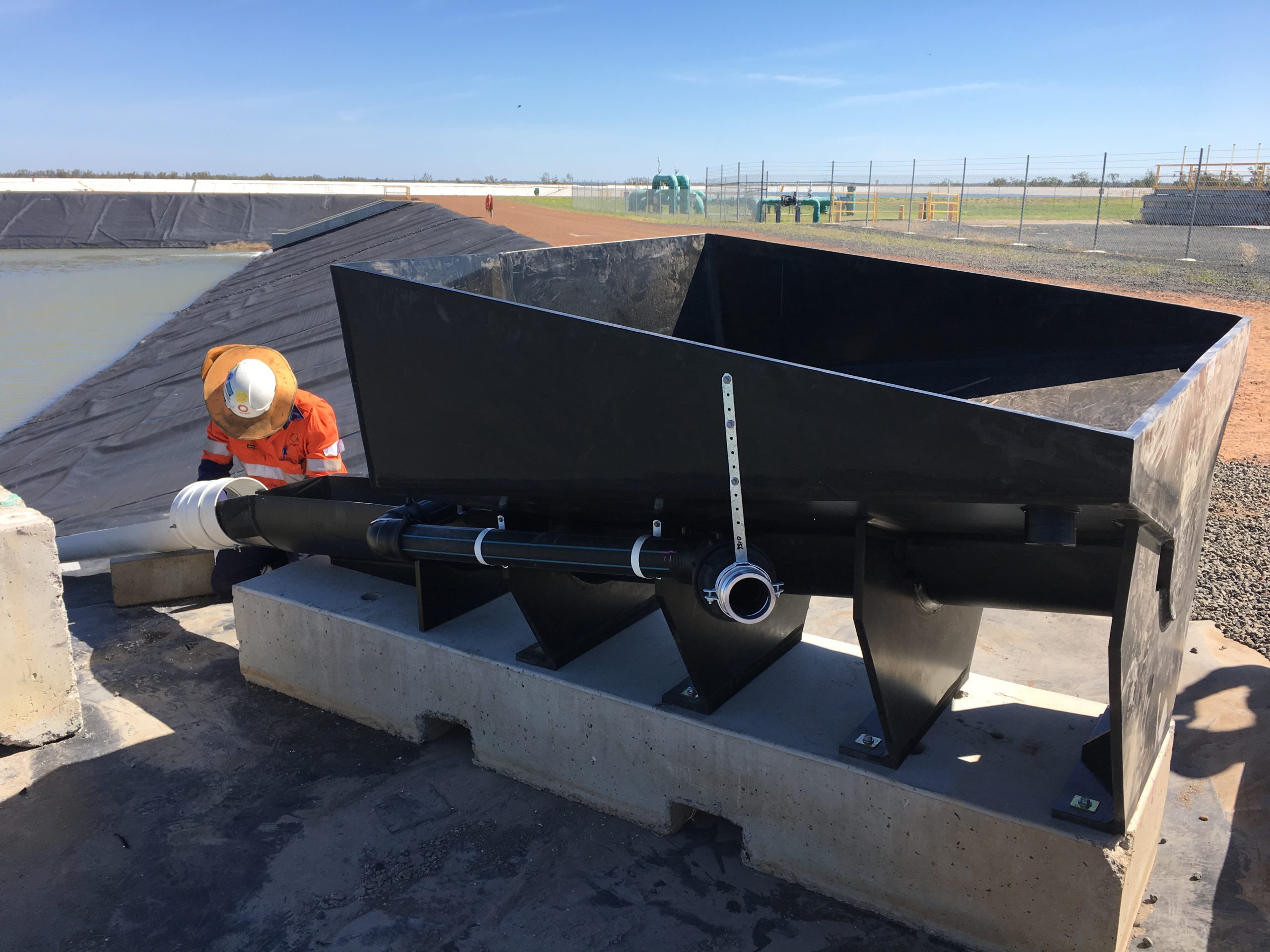
Reference project
Paste Hopper Module — New South Wales
Industrial Plastics completed the design and fabrication of a paste hopper module for a pipe and welding customer. The project required stiffeners, a conical bottom tank, flanges, moulded access door and locating plates. Custom product completed and delivered to regional New South Wales.
- Material
- HDPE Black PE100, 15 mm thick
- Dimensions
- 1.95 m W × 1.88 m H
- Geometry
- Conical bottom, stiffened walls
- Sector
- Pipe Welding
- Location
- New South Wales, Australia
Get an engineer-grade quote
Send a sketch with material details (particle size, bulk density, moisture, flowability), required throughput, footprint constraints and any discharge mechanism you want integrated — or just a written brief. Our technical sales team will respond within one business day with a sized proposal. Or call 1300 465 888, Mon–Fri 8am–4pm AEST.
Send drawings & specs → Call 1300 465 888