What are Fish Baffles?
Fish baffles facilitate fish migration through man-made obstacles, allowing them to feed, spawn and thrive, which ultimately protects the ecological health of our waterways. They have also been strategically implemented to improve erosion control and flood risk management by reducing the velocity of concentrated water flows against riverbanks. Industrial Plastics fabricates PE100 high-density polyethylene (HDPE) to AS/NZS 4130 baffles with custom specifications for your unique applications.
How fish baffles work
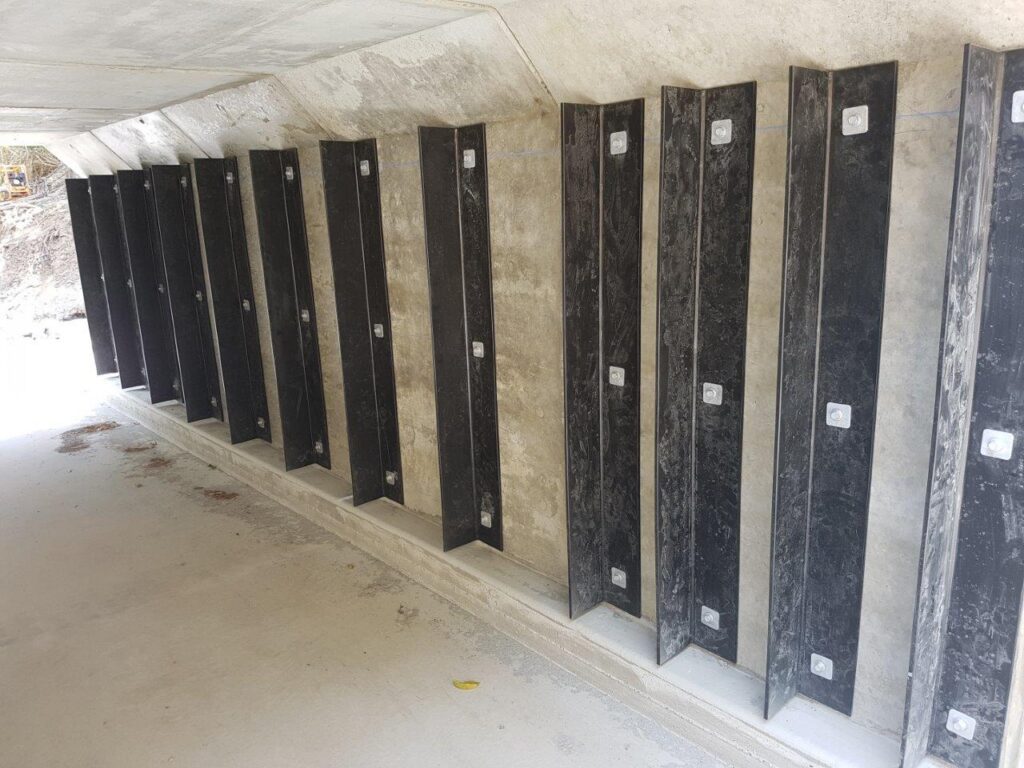
During high-flow and flood events, culverts under roads accelerate water to velocities that exceed the swim speed of native fish — blocking upstream migration, breeding and recolonisation. (Downstream movement is unaffected: fish travel with the current.) Bolted-in baffles break the flow into a sequence of slower-water resting pools, so fish can rest, swim hard, rest again, and progress upstream the full length of the culvert.
Why galvanised steel fails
Legacy fish baffles were galvanised steel. In tannin-rich freshwater and brackish/tidal zones the zinc coating depletes, the steel rusts through and baffles shear off — ending up downstream and leaving the culvert unbaffled. Zinc leaching is also a waterway concern.
Why HDPE outlasts
UV-stabilised PE100 doesn’t corrode, doesn’t leach, and doesn’t fail at the fastener interface. Marine-grade stainless bolts hold the baffle to concrete or steel substrate. Roughly one-eighth the weight of equivalent galvanised steel sections — a typical sidewall baffle is around 5 kg in HDPE versus 35 kg in steel — which keeps install within manual handling thresholds and avoids the mechanical lift requirement that larger steel baffles trigger. Outlasts the structure it’s bolted to.
| Galvanised steel (legacy) | HDPE (Industrial Plastics) | |
|---|---|---|
| Corrosion | Zinc depletes; steel rusts. Service life often 5–10 years in freshwater, less in brackish. | Immune to corrosion. UV-stabilised PE100 service life exceeds 25 years in submerged use. |
| Environmental | Zinc leaches into waterway as coating depletes. | Inert. AS/NZS 4020 grades available where potable contact applies. |
| Failure mode | Rust-through at fastener — baffle shears off, washes downstream. | No corrosion failure. Fastener-rated for design loads with no degradation of host material. |
| Install | Pre-galvanised angle iron, bolt-in via cast-in ferrules. Typical sidewall baffle ~35 kg; weir baffles 100 kg+. Triggers Queensland manual handling controls; mechanical lift often required for larger pieces. | PE100 sheet, bolt-in via cast-in ferrules or M12 316 stainless anchors. Typical sidewall baffle ~5 kg; weir baffles 15–25 kg. Two-person manual handling; no mechanical lift required for typical installs. |
| Approvals | Default solution prescribed in TMR SD1270 / SD1271 (galvanised steel to AS/NZS 3679.1). | Accepted via the SD1270 Note for alternative baffle fixing details — RPEQ-certified to the same DAF ADR geometry and hydraulics. Delivered to TMR, councils, plantation forestry and mining projects across Queensland. ISO 9001:2015 audited by SGS. |
Approvals pathway — how HDPE baffles get accepted
The Department of Agriculture and Fisheries (DAF) Accepted Development Requirements (ADR) set the binding geometric and hydraulic rules for fish baffles in Queensland — protrusion into flow, spacing, sidewall coverage — without naming a material. The Department of Transport and Main Roads (TMR) Standard Drawings SD1270 (red-mapped waterways) and SD1271 (amber-mapped waterways) implement the ADR outcomes with a prescribed galvanised structural steel solution to AS/NZS 3679.1, fabricated to MRTS78.
SD1270 also includes a Note allowing alternative baffle fixing details subject to approval. Industrial Plastics’ high-density polyethylene (HDPE) baffles are accepted via this alternative-submission pathway: a Registered Professional Engineer of Queensland (RPEQ) certifies the HDPE design delivers the same ADR-compliant geometry and hydraulics, with welds to DVS 2207 and ISO 9001:2015-audited manufacture.
How are Fish Baffles used?
Man-made disruptions such as culverts and pipes create adverse water flow conditions and excessive sedimentation. Baffles are implemented in these structures to suit both high flow and low flow conditions.
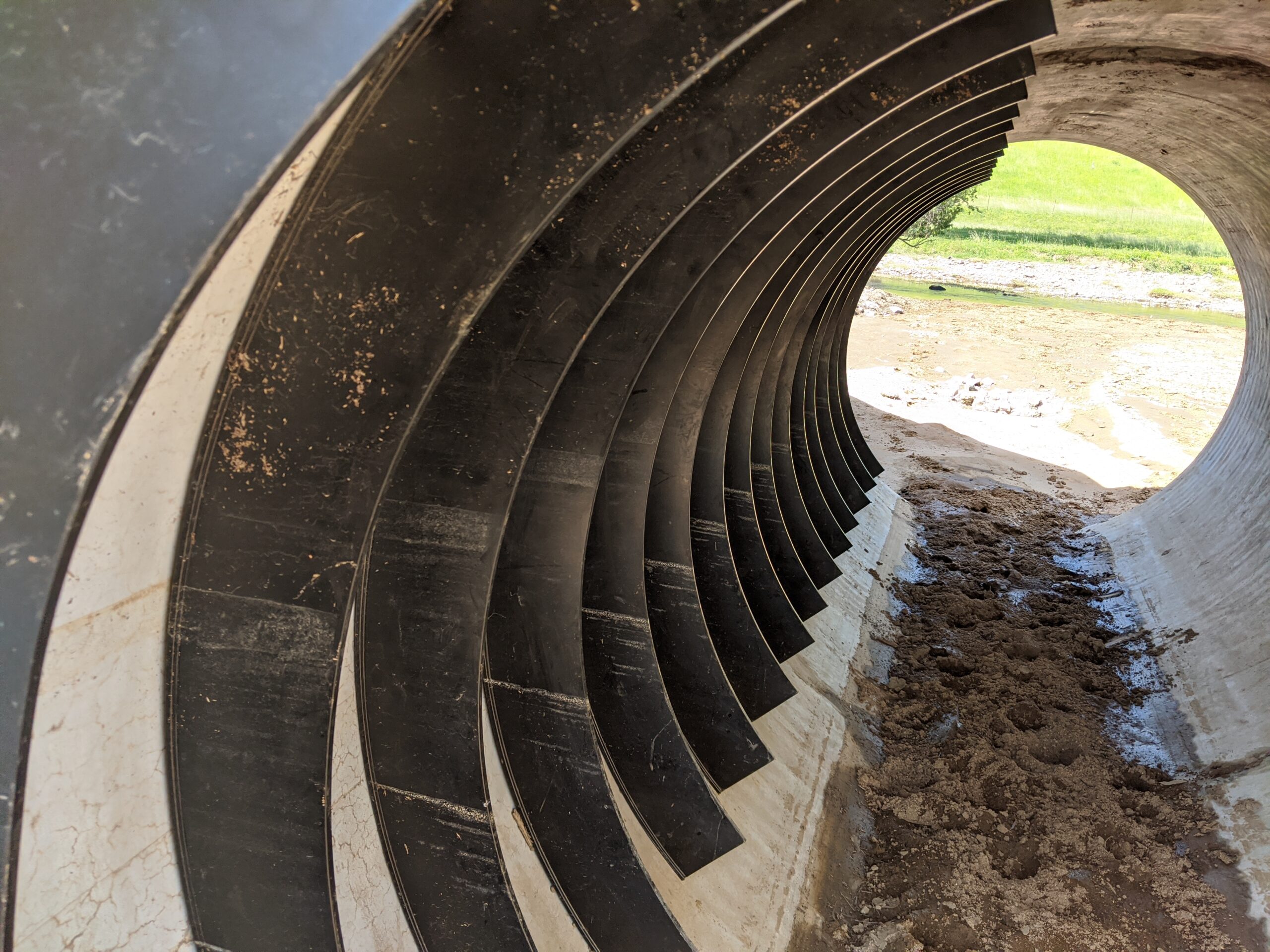
High Flow: Baffles offer hydrodynamic control by reducing the velocity of water currents, creating shelter in the form of eddies and pools, thus minimising energy expenditure of migrating fish.
Low flow: Baffles offer hydrodynamic control by maintaining adequate water depth and hydraulic connectivity within the watercourse, thus promoting oxygenation of the water and fish longevity.
Whether you are part of a council undertaking waterway management initiatives or a farm-owner with your own waterways to protect, Industrial Plastics has the solution for you.
Three baffle types we manufacture
All in PE100 HDPE to AS/NZS 4130. All butt-welded to DVS 2207. All 316 SS fixings.
Vertical sidewall baffles
L-profile angles bolted to alternating culvert sidewalls. The ADR §5.2.1 default for new red-zone culverts and retrofits.
Weir baffles
Full-width plate with notched crest for shallow flows where water depth is the limiting factor. Box and round-pipe variants.
Low-relief spoiler baffles
Staggered floor blocks for small pipe culverts and native small-bodied species. NIWA low-relief pattern.
Each type follows the ADR (September 2025 edition) and suits different culvert geometries. For dimensions, notch geometry and selection criteria, see the Specifier Guide → Part 8. Background reading on all fishway types: What is a fishway? →.
Specifications
- Styles: Vertical Baffles, Weir Baffles, Spoiler Baffles
- Material: High-Density Polyethylene (HDPE)
- Size: Custom
- Thickness: Custom
- Mounting: Custom
Please contact our sales team to discuss designs or request more information
Fish Baffle Brochure

Queensland’s 5-colour waterway zones
Every culvert on a regulated waterway is mapped to one of five colour codes — purple (major impact), red (high impact, mandatory baffles), amber (moderate), green (low), or grey (tidal). The colour determines the design rules under ADR §5.2.1 / §8.2.2.
Quick guide: new box culvert with velocity issue → vertical baffles. Shallow culvert with depth issue → weir baffles. Small pipe retrofit for native species → spoiler baffles. Look up your site at the Queensland Government waterway barrier works mapping (links to DAMS, Queensland Globe and QSpatial with the user guide). Full decision guide and per-zone obligations in the Specifier Guide.
Why Our Solution Works
Historically, baffle solutions in Australia have used concrete and stainless steel. Concrete has proved to be problematic as it is a permanent and non-adjustable solution, lowering its efficacy when the surrounding environment changes. Concrete has also been seen to accumulate debris during flooding, necessitating expensive and frequent maintenance. Stainless steel is also susceptible to corrosion in saline or acidic waterways, significantly reducing its lifespan. Components of stainless steel, such as nickel and chromium may also leach into the water, posing a risk to fish health through the bioaccumulation of metals.
Our HDPE solution:
All these factors also enable our baffles to be easily moved to a different positions to experiment with different hydrodynamic controls.
- can be easily moulded into an array of shapes that suit a variety of different project requirements.
- boasts high chemical resistivity, which is especially important as baffles are exposed to the elements and subject to sewerage spills and overflow.
- has a 100+ year useful life, meaning it is recyclable and can be re-used in other projects.
- is extremely lightweight and affordable, making it simple to transport and install.
Get the 45-page Specifier Guide
ADR dimensions section by section · drop-in tender clauses · 60+ item checklist · case studies · current to September 2025
Download the Guide →Contact Us
Industrial Plastics utilises both in-house testing and external engineers to ensure we provide a meticulously crafted end-product. All our solutions are locally manufactured and backed by our ISO 9001:2015 accreditation, ensuring quality processes and effective results for your project.
Working on a council waterway project?
See Council Fish Baffles → — council-specific fabrication notes for local-government waterway crossings.
Also for council and civil customers:
Planter Box Liners → — HDPE planter box liners for civic landscaping, parks and public realm projects.
Materials we work in for this
Fish baffles are fabricated entirely in HDPE — chemically inert, no rust or zinc leaching, weldable on site.