Lamella Clarifiers
Inclined-plate clarifiers for water treatment, mining and industrial process water — engineer-specified, fabricated in HDPE and polypropylene.
ISO 9001:2015 by SGS · DVS 2207 welders · Brisbane, since 1971
Industrial Plastics designs and fabricates custom Lamella Clarifier modules in HDPE (PE100) and polypropylene (PP-H) for water treatment plants, mining process water, food & beverage effluent, and industrial wastewater clarification. Each module is sized to your influent characteristics — flow rate, solids loading, particle settling velocity and target effluent quality.
Brisbane workshop, since 1971. ISO 9001:2015 certified by SGS. Tanks designed to DVS 2205 and welded to DVS 2207 by qualified welders. Reference installations include council water treatment plants, blue-chip mining operations and industrial process facilities across Australia.
How a Lamella Clarifier works
A Lamella (or inclined-plate) clarifier separates suspended solids from a liquid stream by gravity, using a stack of parallel plates inclined at typically 55–60°. Water flows upward between the plates; solid particles settle onto each plate surface and slide down to a collection sump under gravity, while clarified water exits at the top through a launder.
The geometry multiplies the effective settling area: the projected horizontal footprint of each inclined plate adds to the total settling capacity. A Lamella module with 30–50 plates can deliver the equivalent settling area of a conventional clarifier 5–10× the footprint — the reason they’re specified where space is constrained or capital cost matters.
The engineering parameters that matter
- Plate angle — typically 55° (steeper angle = better self-cleaning, larger footprint per plate; shallower = more compact but solids may build up).
- Surface overflow rate (SOR) — the design flow per unit projected horizontal area. Driven by the slowest-settling particle you need to capture.
- Plate spacing — 50–100 mm typical. Closer = more area per module but higher fouling risk; wider = robust but larger.
- Plate count and module height — sized to deliver the required total settling area for your flow.
- Inlet distribution — even feed flow across all plates. Unequal distribution short-circuits the unit.
- Sludge sump & underflow — conical or pyramid hopper geometry; thickened sludge concentration target dictates underflow rate.
From the workshop

Configurations we fabricate
Modular HDPE clarifiers
Free-standing modules in PE100 black, sized to your water-treatment plant footprint. Self-supporting frame, integrated launder, sludge hopper.
Polypropylene clarifiers
PP-H for higher-temperature service or specific chemical compatibility (acidic effluent, hot CIP wash water, brewery effluent).
Steel-framed plate packs
Plate-pack inserts in galvanised or stainless steel frames, dropped into existing concrete or steel clarifier vessels — capacity upgrade without replacing the basin.
Skid-mounted units
Complete clarifier on a skid with feed pump, dosing point, sludge pump and instrument panel — truck-deliverable for rapid deployment.
Standard features
- HDPE PE100 or PP-H plates and structure, fabricated to DVS 2207.
- Backing rings (galvanised or stainless) on all flanged connections.
- Inlet flow distributor designed to your influent flow profile.
- Spark testing on every weld; hydrostatic test for liquid-tight verification.
- Steel mounting frames, lifting lugs, transport bracing for site delivery.
- Optional: integrated coagulation/flocculation chambers, dosing nozzles, sample taps, viewing windows.
Standards we build to
Compliance
- DVS 2205 — thermoplastic tank design (German engineering standard)
- DVS 2207 — HDPE and PP weld procedures and welder qualification (German plastics welding standard).
- ISO 9001:2015 — quality management system, certified by SGS.
- AS/NZS 4766 — polyethylene storage tanks for water and chemicals (where the clarifier vessel falls under tank specification).
- AS/NZS 4020 — products in contact with drinking water (potable applications).
- Material certificates and weld traceability supplied as part of the project documentation.
Sectors we serve
Water Treatment (Veolia, Aquatec Maxcon, council utilities) · Mining (Rio Tinto, BHP, Glencore — tailings clarification, process water recovery) · Food Processing (effluent pre-treatment, CIP wastewater) · Energy (cooling water clarification, blowdown treatment) · pulp & paper · metal-finishing and plating effluent.
Reference project
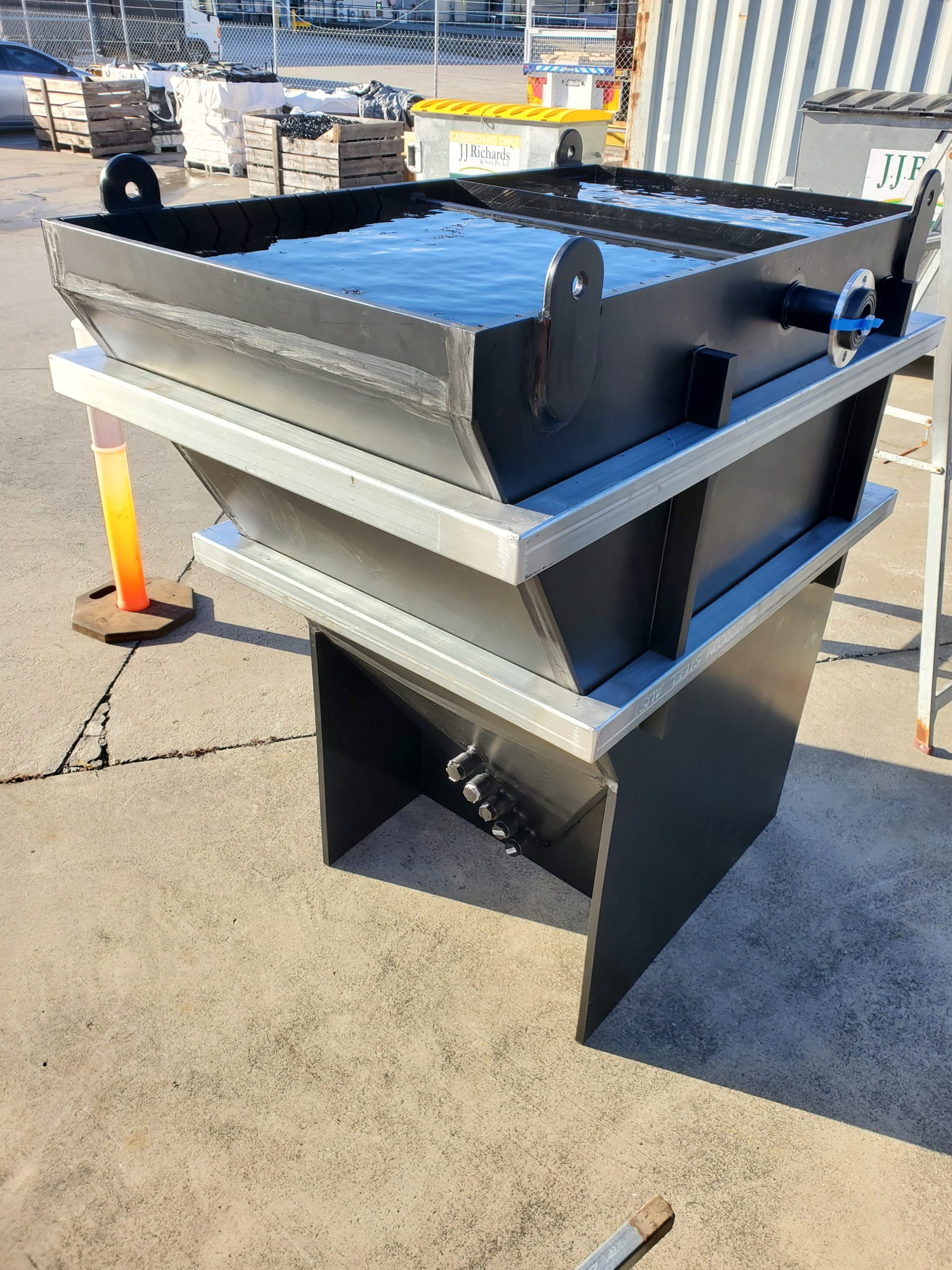
3 × HDPE Lamella Clarifier Modules — Northgate, Queensland
Industrial Plastics completed the fabrication, testing and delivery of three Lamella Clarifier modules for a water treatment project in Northgate, Queensland. The modules separate suspended solids from liquid during the treatment process. The complex fabrication required a specific surface overflow rate, plate area at 60°, spark testing of all welds, plus backing rings, nozzles and steel mounting frames.
- Material
- HDPE Black PE100
- Plate angle
- 60°
- Module dimensions
- 2.4 m L × 2.0 m H × 1.4 m W
- Quantity
- 3 modules
- Sector
- Water Treatment
- Location
- Northgate, Queensland
Get an engineer-grade quote
Send a flow diagram, influent water analysis (TSS, particle size distribution, target effluent quality) and site footprint constraints — or just a written brief. Our technical sales team will respond within one business day with a sized proposal. Or call 1300 465 888, Mon–Fri 8am–4pm AEST.
Send specs & flow diagram → Call 1300 465 888
Materials we work in for this
Lamella clarifiers are typically built from HDPE structural plate with polypropylene where dosing chemistry rules it in.